window.fbAsyncInit = function() { FB.init({ appId : 'KODE-APLIKASI', status : true, // check login status cookie : true, // enable cookies to allow the server to access the session xfbml : true // parse XFBML }); }; (function() { var e = document.createElement('script'); e.src = document.location.protocol + '//connect.facebook.net/en_US/all.js'; e.async = true; document.getElementById('fb-root').appendChild(e); }());

Recent

5/recent-posts
Showing posts with label Air Pollution. Show all posts

Saturday, June 10, 2023

thumbnail

Water pollution


   Water pollution


 Water is typically referred to as polluted when it is impaired by anthropogenic contaminants. Due to these contaminants it either does not support a human use, such as drinking water, or undergoes a marked shift in its ability to support its biotic communities, such as fish. Natural phenomena such as volcanoes, algae blooms, storms, and earthquakes also cause major changes in water quality and the ecological status of water.

Water pollution is a major global problem. It requires ongoing evaluation and revision of water resource policy at all levels (international down to individual aquifers and wells). It has been suggested that water pollution is the leading worldwide cause of death and diseases.Water pollution accounted for the deaths of 1.8 million people in 2015.

Water pollution


Diseases: In humans, drinking or consuming polluted water in any way has many disastrous effects on our health. It causes typhoid, cholera, hepatitis and various other diseases. Destruction of Ecosystems: Ecosystems are extremely dynamic and respond to even small changes in the environment.                Bangladesh – one of the most densely populated countries of the world— has plentiful water sources, but these sources are being polluted continuously. Both surface water and groundwater sources are contaminated with different contaminants like toxic trace metals, coliforms as well as other organic and inorganic pollutants. As most of the population uses these water sources, especially groundwater sources which contain an elevated amount of arsenic throughout the country; health risk regarding consuming water is very high. Death due to water-borne diseases is widespread in Bangladesh. That is why pollution should be stopped and proper methods should be taken against it.

What is water pollution?

Water pollution

Water pollution is the release of substances into bodies of water that makes water unsafe for human use and disrupts aquatic ecosystems. Water pollution can be caused by a plethora of different contaminants, including toxic waste, petroleum, and disease-causing microorganismspollution is the contamination of water bodies, usually as a result of human activities. Water bodies include for example lakes, rivers, oceans, aquifers and groundwater. Water pollution results when contaminants are introduced into the natural environment. For example, releasing inadequately treated wastewater into natural water bodies can lead to degradation of aquatic ecosystems. In turn, this can lead to public health problems for people living downstream. They may use the same polluted river water for drinking or bathing or for irrigation. Water pollution is the leading worldwide cause of death and disease, e.g. due to water-borne diseases.Water is typically referred to as polluted when it is impaired by anthropogenic contaminants. Due to these contaminants it either does not support a human use, such as drinking water, or undergoes a marked shift in its ability to support its biotic communities, such as fish. Natural phenomena such as volcanoes, algae blooms, storms, and earthquakes also cause major changes in water quality and the ecological status of water.

Water pollution is a major global problem. It requires ongoing evaluation and revision of water resource policy at all levels (international down to individual aquifers and wells). It has been suggested that water pollution is the leading worldwide cause of death and diseases.Water pollution accounted for the deaths of 1.8 million people in 2015.


Diseases: In humans, drinking or consuming polluted water in any way has many disastrous effects on our health. It causes typhoid, cholera, hepatitis and various other diseases. Destruction of Ecosystems: Ecosystems are extremely dynamic and respond to even small changes in the environment.                                      Bangladesh – one of the most densely populated countries of the world— has plentiful water sources, but these sources are being polluted continuously. Both surface water and groundwater sources are contaminated with different contaminants like toxic trace metals, coliforms as well as other organic and inorganic pollutants. As most of the population uses these water sources, especially groundwater sources which contain an elevated amount of arsenic throughout the country; health risk regarding consuming water is very high. Death due to water-borne diseases is widespread in Bangladesh. That is why pollution should be stopped and proper methods should be taken against it.

Water pollution

thumbnail

Human Health,


HUMAN HEALTH


Air pollution cuts life expectancy on every being on Earth by nearly two years, according to data released Tuesday (28.07.2020) experts say that the data showed poor air quality which refers to "the greatest risk to human health".In countries such as India and Bangladesh, air pollution was so severe that it now cuts average lifespans in some areas by nearly a decade.

Authors of the research said the quality of the air which many humans breathe constituted a far higher health risk than COVID-19.

"Though the threat of coronavirus is grave and deserves every bit of the attention it is getting, embracing the seriousness of air pollution with a similar vigour would allow billions of people to lead longer and healthier lives," said Michael Greenstone, creator of AQLI.

Nearly a quarter of the global population lives in just four south Asian countries that are among the most polluted - Bangladesh, India, Nepal and Pakistan.

AQLI found that these populations would see their lifespan cut by five years on average, after being exposed to pollution levels 44 percent high Bangladesh was found to have the worst air quality of any country, and around 250 million residents of India's northern states will lose eight years of life on average unless pollution is brought under control.

Several studies have shown exposure to air pollution is also a key COVID-19 risk factor, and Greenstone urged governments to prioritise air quality after the pandemic.
"No shot in the arm will alleviate air pollution," said Greenstone, from the Energy Policy Institute at the University of Chicago.
"The solution lies in robust public policy," he said.


Human Health
thumbnail

Air Pollution

Air pollution


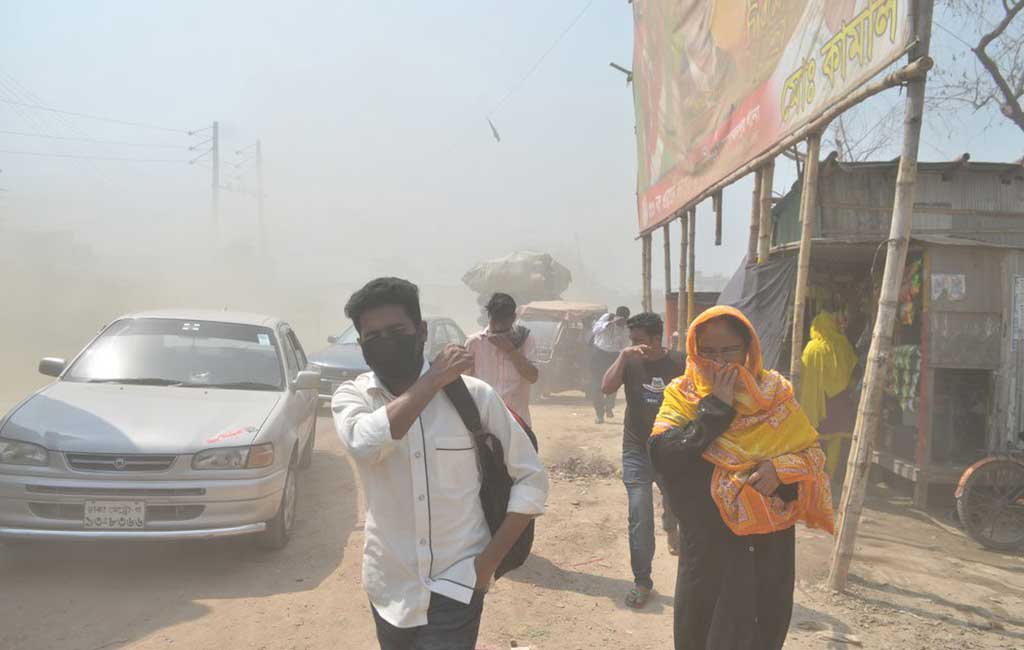
Bangladesh has been listed amongst the world's most polluted countries for PM2.5 exposure while Dhaka has emerged as the second most polluted city in the 2019 World Air Quality Report.  

Although Bangladesh has seen little progress compared to the 2018 rankings, its air is still unhealthy. 

Despite various government policies to address the issue, Dhaka's air quality has dropped from where it was two years ago.

The United Nations says PM2.5 density should not top 25 micrograms per cubic metre of air in any given 24-hour period.

Being among the world's megacities of 10 million people or more, the annual average PM2.5 concentration in Dhaka's air in 2019 was 83.3 micrograms per cubic metre.

Air Pollution


Referring to the situation in Dhaka, Kinkar Ghosh, epidemiologist at Dhaka Shishu Hospital, said air pollution has both short-term and long-term impacts on the public health. 

"Inhaling particles that are in the air leads to breathing problems, dust allergy and skin problem called dermatitis," he told The Business Standard. 

Pakistan, India among 10 most polluted nations 

Pakistan, India and Nepal are among the 10 most polluted countries on the index, with Pakistan ranked second and India fifth.

Delhi is ahead of Dhaka and tops the list of the most polluted cities, with Kabul and Kathmandu also among the top 10.

The report focuses on PM2.5 concentrations as this is the pollutant widely regarded as the most harmful to human health. 

Data aggregated from a range of ground-based PM2.5 monitoring stations have been used to prepare the report published on Tuesday by IQAir. The report is based on data from nearly 5,000 cities worldwide. 

Headquartered in Switzerland, IQAir collaborates with leading organisations and partners who work for making the world a better place to breathe.  

South Asia's air most polluted

The report said regionally, South Asia, Southeast Asia, and Western Asia carry the highest burden of PM2.5 pollution overall.  

Of the world's top 30 most polluted cities in 2019, 21 are in India, 27 in South Asia, and all the top 30 cities are within greater Asia.

While South Asia has the world's dirtiest air, 35 percent of global air pollution-related deaths occur in East Asia

Air Pollution


China

Climate change has begun to amplify the health risk of PM2.5 pollution, especially through more intense forest fires and sandstorms made worse by spreading desertification, the report said.

Air pollution far deadlier than coronavirus 

"Air pollution is the world's leading environmental health threat," said IQAir Chief Executive Officer Frank Hammes. 

"While the new coronavirus is dominating international headlines, a silent killer is contributing to nearly seven million more deaths a year: air pollution," he added.

Air pollution continues to pose one of the biggest threats to human health, with nearly 90 percent of the global population breathing air that exceeds World Health Organisation exposure targets, the report said.

Scandinavia has cleanest air

Europe has some of the world's cleanest air, with Scandinavian skies among the world's healthiest. 

But the continent is still struggling to control emissions from sources such as livestock, vehicles, industry, and commercial buildings, said the report. 

More than a third of European cities are failing to meet the World Health Organisation's air quality guidelines, with the poorer eastern and southern parts of the continent suffering from the worst quality air. 


About

3/Photography/post-per-tag
Powered by Blogger.

Facebook

Followers

Search This Blog

Blog Archive

Fashion

3/Fashion/post-per-tag

Beauty

3/Beauty/post-per-tag
google-site-verification: googlee0b0435b30d717fc.html

Videos

3/Food/recent-videos

Technology

3/Technology/small-col-left

Sports

3/Sports/small-col-right

Fashion

3/Fashion/big-col-right

Nature

3/Nature/post-grid

Business

3/Business/big-col-left

Header Ads

Header ADS

Subscribe Us

Music

3/Music/post-grid